

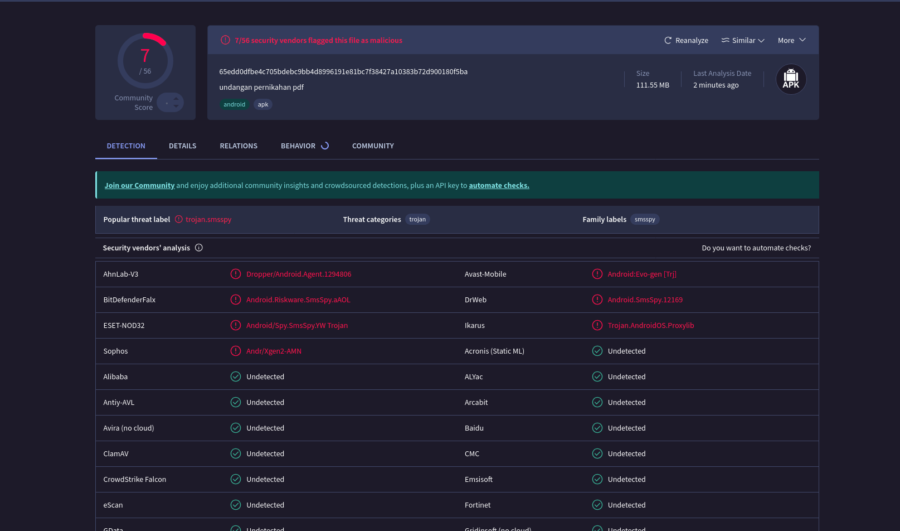

Virustotal report scan on the fake invitation APK malware file
Dissecting an SMS Stealer and Telegram-Based Spyware Disguised as an Invitation App
This malware analysis (File Hash: 65edd0dfbe4c705bdebc9bb4d8996191e81bc7f38427a10383b72d900180f5ba) was conducted based on a real incident that occurred in Riau, where the WhatsApp account of the Acting Governor of Riau was reportedly hacked and used to send malicious files to his contacts (source: mediacenter.riau.go.id). One of the message recipients downloaded and installed the file that was sent, causing their device to become infected and automatically spread the same APK file to all of their WhatsApp contacts.
The APK sample analysed in this article was obtained directly from a victim who received the file. To understand the impact and risks involved, the following section presents a technical analysis of the Android malware that was distributed through this fake invitation app scheme.
Before conducting an in-depth code analysis, the APK sample was first tested using VirusTotal as an initial triage step. The scan results showed that the file was not clean and posed a high risk.
According to the VirusTotal report, several security engines (7 out of 56 vendors) flagged this sample as malicious, with classifications pointing to the categories of trojan, spyware, and SMS stealer. Some of the labels that appeared indicated the application’s ability to intercept SMS, monitor user activity, and exfiltrate data without the victim’s knowledge.
The analysed Android application sample exhibited malicious behaviour consistent with an SMS stealer, notification exfiltration, and automated SMS sending, with the Command & Control (C2) / exfiltration channel using the Telegram Bot API. The application requests RECEIVE_SMS and SEND_SMS permissions, monitors notifications through an internal broadcast mechanism, and then sends notification content and SMS to a hardcoded Telegram endpoint. Once permissions are granted, the application also sends an SMS beacon/ping to a specific mobile number.
Key impact:
- SMS theft (including potential OTP/2FA codes).
- Application notification exfiltration (potentially OTP, transactions, emails, etc.).
- Automated SMS sending (fraud and takeover risk).
- Device metadata leakage.
Scope & Evidence Artefacts
Code artefacts (decompiled):
payload_jadx/sources/com/example/myapplicatior/MainActivity.javapayload_jadx/sources/com/example/myapplicatior/ReceiveSms.javapayload_jadx/sources/com/example/myapplicatior/SendSMS.javapayload_jadx/sources/com/example/myapplicatior/NotificationService.javaout_apktool/smali_classes3/com/example/droppevabc963/MainActivity.smali
Analysis Methodology
- Intake & Evidence Handling
- Artefact inventory, hashing, and evidence storage (chain-of-custody).
- Static Triage
- IOC search (bot token, chat_id, phone numbers, domains/URLs, IPs).
- Reverse Engineering (Static)
- Decompilation (JADX) to read the application logic.
- Smali validation (apktool) to confirm entry points and intents/actions.
- Behavioral Mapping
- Permission-to-runtime-function mapping.
- Data flow mapping (source to sink).
- IOC Extraction
- Normalisation of infrastructure indicators (C2, target chat, beacon number).
- Impact Assessment
- Risk assessment of account takeover, fraud, and data leakage.
- Detection & Mitigation
- Endpoint/network recommendations for enterprises.
Key Findings
Finding 1 — Telegram Bot API Used as C2/Exfiltration Channel
Evidence:
Telegram Bot API URL strings with sendMessage were found in:
payload_jadx/sources/com/example/myapplicatior/MainActivity.java(multiple locations)payload_jadx/sources/com/example/myapplicatior/ReceiveSms.javapayload_jadx/sources/com/example/myapplicatior/SendSMS.java
This application sends collected data to the Telegram Bot API (HTTPS) as its C2/exfil channel.
Finding 2 — Application Notification Exfiltration (Notification Harvesting)
Technical evidence (MainActivity.java):
The onNotice receiver extracts extras:
packagetitletext
then sends them to the Telegram endpoint usingOkHttpClient.
Notifications from applications are treated as a source of sensitive data and exfiltrated. This is used to spy on notifications such as OTP notifications or transaction information from banking apps or OTPs from other accounts, such as WhatsApp and others.
Finding 3 — SMS Interception & Exfiltration (SMS Stealer)
Evidence:ReceiveSms.java constructs a “TERIMA SMS BARU” (NEW SMS RECEIVED) message containing:
- sender (
originatingAddress) - SMS content
- device type
then sends it to Telegram viasendMessage.
This capability enables the theft of SMS-based OTP/2FA codes and other sensitive information.
Finding 4 — Automated SMS Sending and Status Reporting
Evidence:SendSMS.java sends a status message “Berhasil Kirim SMS dari Jauh …” (Successfully Sent SMS Remotely …) to Telegram.
The application has the capability to send SMS programmatically and report the results, indicating a control/automation function.
Finding 5 — Permission Gate for RECEIVE_SMS and SEND_SMS
Evidence (MainActivity.java):
The application requests permissions:
android.permission.RECEIVE_SMSandroid.permission.SEND_SMS
These permissions are crucial for the SMS stealer and SMS sender functions. The permission gate pattern indicates that the malware’s operational flow depends on user approval.
Finding 6 — SMS Beacon/Ping after Permissions Are Granted
Evidence (MainActivity.java):

The SMS beacon/ping to a specific number is used to mark an active installation or for control synchronisation.
Finding 7 — Internal Broadcast Mechanism “Msg” for Notifications
Evidence:

NotificationService.javacreates anIntent("Msg")MainActivity.javaregisters areceiver IntentFilter("Msg")
The notification collection component is separated from the exfiltration component. This architecture is common for facilitating background data collection.
Execution Flow Analysis (Step-by-Step)
1 Initialisation
- The application loads a WebView-based UI (potentially as a cover/lure).
- JavaScript on the WebView is enabled.
2 Permission Handling
- On modern Android versions, the application checks for RECEIVE_SMS and SEND_SMS permissions.
- If not yet granted, the application triggers a permission request.
3 Post-Permission Granted
- Sends an installation/device status notification to the Telegram Bot API.
- Sends an SMS beacon
"*"to a designated number. - Activates a receiver for the internal “Msg” broadcast so that captured notifications can be exfiltrated.
4 Data Collection & Exfiltration
- Notifications: sent to Telegram (package/title/text).
- Incoming SMS: sent to Telegram (originator + content).
- SMS sending status: sent to Telegram.
IOC (Indicators of Compromise)
For broad distribution, masking is recommended. The internal version retains full values.
1 C2 / Exfiltration
- Platform: Telegram Bot API
- Domain:
api.telegram.org - Function:
sendMessage - Bot token:
8333428093:AAGH-i6**bot_token_redacted***j5Pk*** - Recipient Chat ID:
7766****38(Telegram ID redacted; for law enforcement inquiries related to this matter, please contact ATIOS)
2 Telephony
- Beacon/ping number:
0821****3851(mobile number also redacted; for law enforcement inquiries related to this matter, please contact ATIOS)
3 Code Artefacts
com.example.myapplicatior.MainActivitycom.example.myapplicatior.ReceiveSmscom.example.myapplicatior.SendSMScom.example.myapplicatior.NotificationService
Full Attack Chain
Risk Assessment (Enterprise Impact)
- Account Takeover: OTPs via SMS and notifications can be exfiltrated.
- Financial Fraud: Banking notifications and verification SMS are at risk of leakage.
- Data Leakage: SMS and notifications may contain personal/sensitive data.
- Operational Risk: Automated SMS sending can be exploited for fraud and propagation.
Quick Recommendations (for the Public)
If you have already installed the app:
-
Uninstall the application
-
Revoke sensitive permissions (SMS, notifications, install unknown apps) if you have not yet uninstalled
-
Change passwords for important accounts (email, WhatsApp, banking, marketplace)
-
Re-enable 2FA (using an authenticator app is safer than SMS)
-
Check login activity / connected devices on your important accounts
-
If there are suspicious transactions/OTPs: contact your service provider immediately
Detection & Mitigation (Enterprise Controls)
1. Endpoint/MDM
- Block applications that request RECEIVE_SMS + SEND_SMS without a business justification.
- Audit applications that request notification access and background activity.
- Isolate and remove samples from affected devices.
2. Network
- Monitor/alert on traffic to api.telegram.org, particularly paths containing /bot and /sendMessage.
- Proxy rules/IDS signatures for Telegram Bot exfil patterns.
3. Awareness
- Prevent installation of “invitation/PDF viewer” APKs from unofficial sources.
- Educate users about red flags: SMS permission requests from irrelevant applications.
Conclusion: Key Lessons
This case confirms that cyber threats often disguise themselves as something that appears normal and close to everyday life. A file that looks like an “invitation” can become a gateway to data theft when users grant application permissions without verification.
The key lesson is simple: an application’s function must align with the permissions it requests. An application that only displays a document does not need access to SMS, notifications, or permission to install from other sources. This mismatch is a red flag that must not be ignored.
ATIOS encourages the public to be more vigilant about applications from outside official app stores, to understand the risks of application permissions, and to make digital awareness the first line of defence in protecting personal data security. ***
Written by:
Irvannanda (Chairman of ATIOS)