

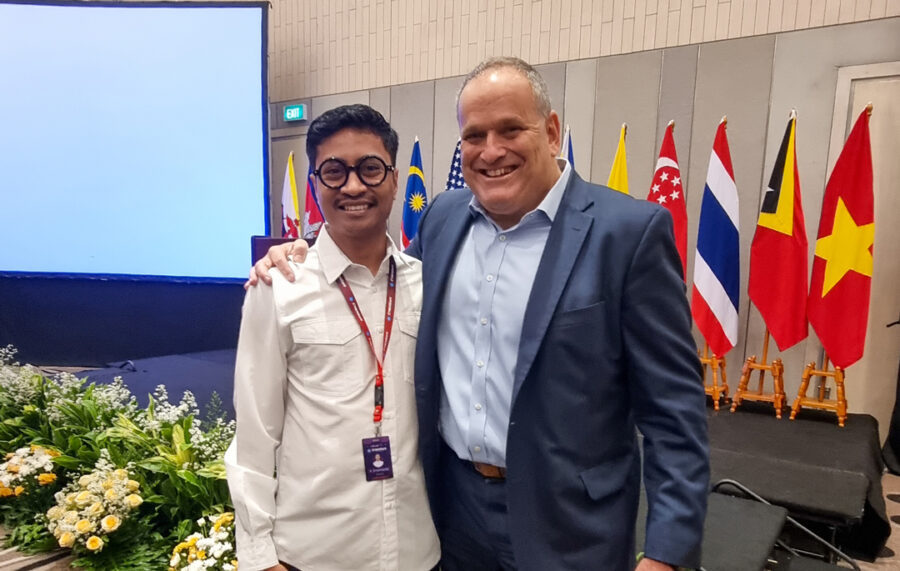

ATIOS.ID, Jakarta– Chairman of the Asosiasi Teknologi Informasi & Open Source (ATIOS), Azwir Irvannanda, participated as a training participant at the opening of the YSEALI CyberSafe ASEAN Workshop 2026 (27/1) held at the Double Tree by Hilton Hotel, Cikini, Jakarta. This regional programme focuses on combating organised transnational digital crime, including online scams (online scams) operated through structured criminal networks, scam operation centres (scam compounds), and transnational cybercrime ecosystems that directly impact the security, humanitarian conditions, and stability of the Southeast Asian region.
YSEALI CyberSafe ASEAN is part of the Young Southeast Asian Leaders Initiative (YSEALI), an official initiative of the United States Government through the U.S. Department of State, with support from the U.S. Mission to ASEAN. The programme is designed as a capacity building (capacity building) training and regional collaboration to respond to increasingly complex, organised, and cross-jurisdictional digital crime threats.
The first day’s opening began with official remarks from Joy M. Sakurai, Chargé d’Affaires of the U.S. Mission to ASEAN, who emphasised the importance of cross-border and cross-sector cooperation in safeguarding ASEAN’s digital space. Strengthening human resource capacity, information sharing, and regional collaboration were identified as key to confronting digital criminal networks that operate in an organised and systematic manner.

The opening session continued with opening remarks from Robert T. Koepcke, Deputy Assistant Secretary of the U.S. Department of State, who affirmed that online fraud practices in Southeast Asia have evolved into part of a transnational cybercrime ecosystem, including the existence of scam compounds that function as fraud operation centres with organisational structures resembling criminal organisations or digital mafias. This pattern causes serious impacts, not only economic losses but also humanitarian and regional security concerns.
The first day of training also featured a keynote speech from Scott Augenbaum, a cybercrime prevention expert and former FBI agent. In his presentation, he emphasised the importance of building a cybersecure mindset, positioning the human factor as the critical point in the attack chain. According to him, organised digital criminal networks—including those operating from scam compounds—systematically exploit victims’ psychological aspects through phishing, social engineering, and trust manipulation.
The YSEALI CyberSafe ASEAN 2026 programme was attended by approximately 60 selected participants from all ASEAN member states, coming from diverse cross-sector backgrounds. Participants included representatives of civil society, academics and researchers, technology and cybersecurity practitioners, public policymakers, the financial and anti-fraud sector, as well as digital advocacy and literacy communities. This diversity was designed to ensure a multidisciplinary and collaborative approach to understanding and formulating solutions to organised digital crime threats.
As an active participant, the ATIOS Chairman attended all opening sessions alongside participants from various ASEAN countries. This participation reflects ATIOS’s commitment to continuously strengthening the organisation’s internal capacity, deepening practical understanding of the patterns, networks, and ecosystems of organised digital crime—including the scam compounds phenomenon, as well as expanding regional collaborative networks in efforts to prevent and counter cross-border cyber threats.
The workshop will run until 30 January 2026, with a continuing agenda comprising thematic discussions, cross-country working groups (strike teams), concrete solution design, and final presentations. The programme also opens opportunities for a post-workshop phase, where selected teams will have the chance to receive further support to test solutions developed in their respective communities.
Through direct involvement in this regional training, ATIOS affirms its approach based on learning, collaboration, and concrete action in confronting organised transnational digital crime—including scam compound-based fraud practices—as well as strengthening the role of civil society and technology communities in maintaining a safe, ethical, and responsible digital space in the ASEAN region. (PA/FDLN)