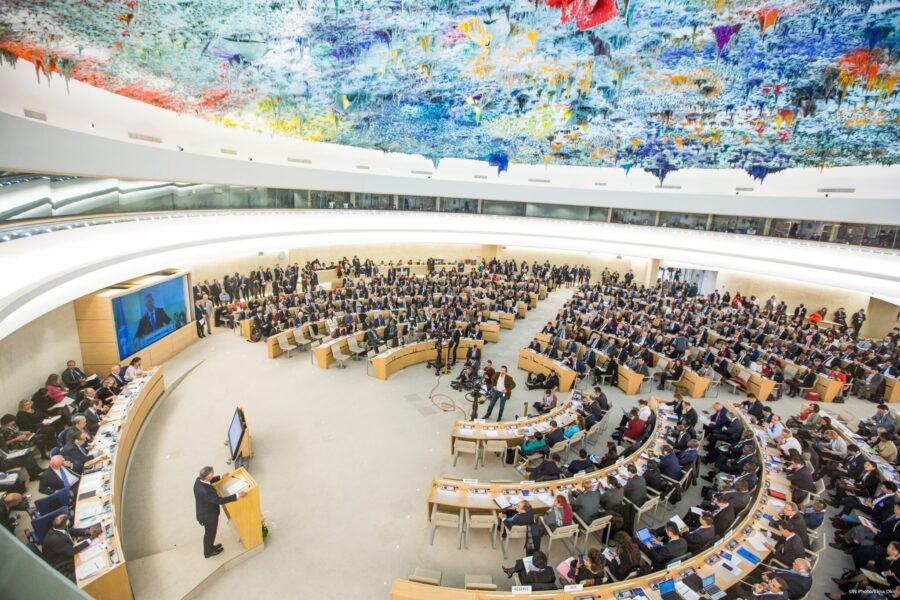

The Association for Information Technology & Open Source (ATIOS) observes the nomination of the Republic of Indonesia as the sole candidate for the Presidency of the United Nations Human Rights Council (UNHRC) for 2026, as determined through the Asia-Pacific Group mechanism.
From a civil society perspective, this nomination constitutes part of the multilateral leadership cycle that carries strategic significance for global human rights governance. The Presidency of the Human Rights Council is not a representation of a state’s national interests, but rather a mandate to facilitate processes, maintain balance among members, and ensure the continuity of dialogue within an increasingly complex and fragmented international order.
Human Rights in an Increasingly Digital World
In contemporary life, the digital sphere no longer exists as a space separate from human existence. It has become a primary living environment—where people work, learn, communicate, participate politically, and access public services. As a result, nearly all dimensions of human rights are now directly intertwined with the digital domain.
The right to privacy, freedom of expression, access to information, freedom of assembly, and protection from discrimination are increasingly mediated by technology. As digital identity, personal data, and online footprints become integral to modern human existence, the protection of human rights can no longer be confined to the physical world alone.
At this point, technology—including artificial intelligence (AI), automated systems, and data analytics—has become a determining factor in how human rights are exercised, protected, or, in some cases, violated.
Modern Conflict: Physical Warfare, Cyber Warfare, and Intelligent Technologies
These realities are further reinforced by the nature of contemporary global conflict. Modern warfare is no longer limited to physical battlefields, but also unfolds within cyberspace and technological domains. Cyberattacks targeting civilian infrastructure, communication systems, healthcare services, energy, and financial sectors have become part of today’s conflict dynamics.
In addition, the use of AI, autonomous systems, surveillance technologies, and data analytics in security and military contexts has expanded the scope of human rights challenges. Decisions with direct consequences for human safety are increasingly influenced by algorithmic systems, often with limited transparency, accountability, and public oversight.
In this context, civilian populations are the most vulnerable. The impacts of cyber warfare and advanced technologies are not confined to conflict zones but extend across borders, populations, and generations.
Privacy and Data as Core Human Rights
In the era of digital conflict, data and digital identity have become strategic assets. The collection, processing, and exploitation of personal data—by both state and non-state actors—can be used for profiling, mass surveillance, disinformation, and technologically driven targeting.
These practices have direct implications for the right to privacy and the protection of personal data, now widely recognized as integral components of human rights. Without clear legal frameworks, effective oversight mechanisms, and strong accountability principles, the use of technology risks eroding fundamental human rights, particularly during times of crisis and conflict.
Regulatory and Global Governance Challenges
ATIOS views these developments as underscoring the urgent need to strengthen global governance of technology, particularly in relation to human rights, cybersecurity, and AI. Existing international legal frameworks—largely designed for physical conflicts and traditional inter-state relations—must continue to evolve in order to remain relevant.
Issues such as cyber warfare, the use of AI in security contexts, cross-border data protection, and accountability of state and non-state actors require inclusive, adaptive, and human-rights-based multilateral approaches.
In this regard, the United Nations Human Rights Council plays a strategic role in promoting global norms, principles, and dialogue to ensure that technological advancement does not come at the expense of human dignity.
Indonesia’s Relevance in the Multilateral Framework
ATIOS assesses that Indonesia’s nomination for the Presidency of the Human Rights Council should be understood within this multilateral framework. In this role, Indonesia is expected to perform administrative and facilitative functions that emphasize inclusivity, consensus, and balance.
Policy statements delivered by Natalius Pigai, Minister of Human Rights of the Republic of Indonesia, regarding Indonesia’s readiness to work in accordance with the mandate and mechanisms of the Human Rights Council, as well as affirmations by Sugiono, Minister of Foreign Affairs of the Republic of Indonesia, concerning commitments to professionalism and multilateralism, provide initial context for understanding Indonesia’s intended approach.
For ATIOS, the primary focus lies not in symbolic leadership, but in the quality of mandate implementation in responding to human rights challenges increasingly shaped by technology and AI.

ATIOS Chairman Irvannanda Signs Strategic Memorandum of Cooperation at the Global South NGO Platform, Baku – Azerbaijan (29/4/2025)
ATIOS Position
In its capacity as a civil society organization with Special Consultative Status and active engagement within Global South NGO networks, ATIOS expresses its support for Indonesia’s candidacy for the Presidency of the UN Human Rights Council in 2026, with the understanding that this role must be carried out with neutrality, professionalism, and multilateral responsibility.
This support is functional and contextual, grounded in the need for Human Rights Council leadership that can:
-
facilitate balanced dialogue across diverse interests,
-
uphold the credibility of multilateral processes,
-
and open space for addressing contemporary human rights issues increasingly intertwined with technology, AI, and cybersecurity.
Global South Perspectives and the Role of Civil Society
As part of Global South civil society networks, ATIOS views global human rights leadership as needing greater sensitivity to the experiences of developing countries, particularly in confronting the impacts of technology on development, security, and social cohesion.
In this context, ATIOS encourages the Human Rights Council to strengthen its focus on:
-
privacy and personal data protection within global technology and AI ecosystems,
-
cybersecurity as an element of civilian protection,
-
governance of AI and intelligent systems grounded in non-discrimination, accountability, and justice,
-
and the strengthening of public trust in technology as a prerequisite for social stability.
These issues require equitable engagement among states, civil society, the private sector, and the international community.

ATIOS, Alongside Several NGOs, Signs Strategic Memorandum of Cooperation
ATIOS’ Role
Within this dynamic environment, ATIOS positions itself as a civil society actor committed to substantive contributions through policy analysis, multi-stakeholder dialogue, and knowledge exchange at the intersection of human rights, technology, AI, security, and global governance.
This approach aims to enrich international human rights discourse and promote policy responses aligned with the realities of an increasingly digitalized and automated world.
Conclusion
Indonesia’s nomination for the Presidency of the UN Human Rights Council in 2026 occurs at a pivotal moment in global governance. In the era of technology and AI, human rights can no longer be separated from digital dynamics, modern conflict, and technological transformation.
ATIOS considers that, if exercised professionally and with openness to broad stakeholder input, leadership of the Human Rights Council can contribute positively to strengthening the relevance and credibility of the international human rights system, while ensuring that technological progress remains aligned with human dignity and fundamental human rights.
ATIOS — Civil Society Perspectives on Human Rights, Technology, AI, and Global Governance.